
The Swift Capture of a Criminal: Mark T.'s Cloned Card Saga
A Florida man bought six cloned debit cards on a darknet marketplace for $480 in November 2024. Fifteen days later, he was arrested after ATM cameras captured his face during cash withdrawals.
- Date
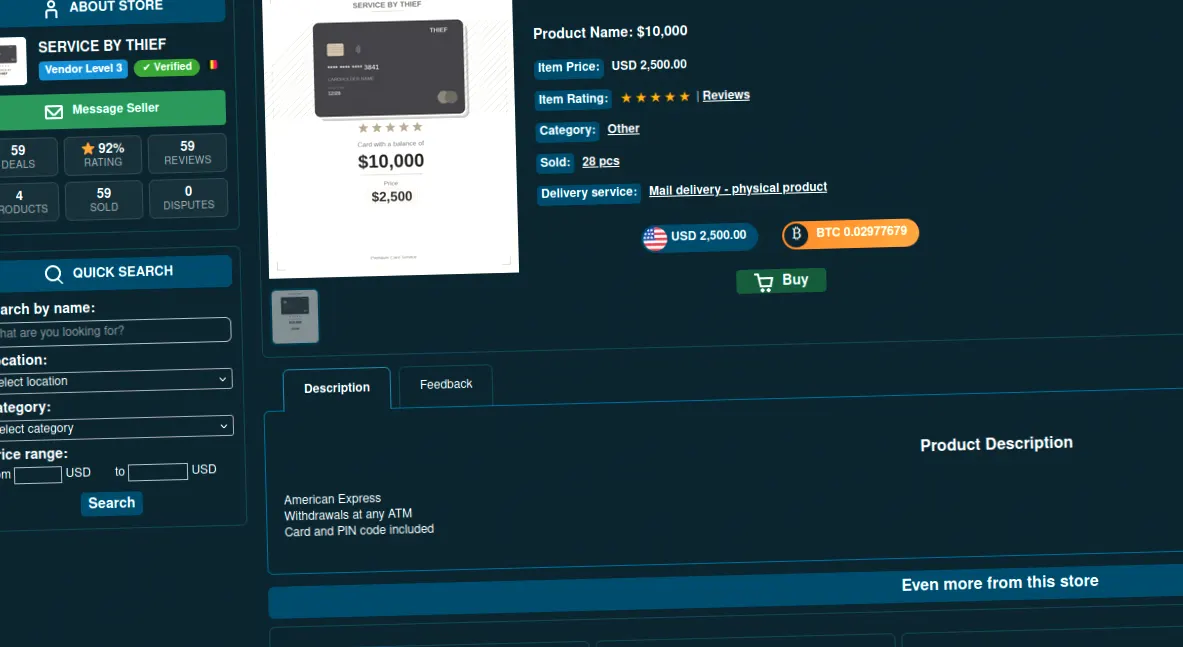
Mark T., a 34-year-old individual from Tampa Bay, thought he had discovered an easy way to make money. He bought six cloned debit cards along with their PINs in November 2024, spending $480 in cryptocurrency for the transaction. These cards contained illegal magnetic stripe information linked to real bank accounts. He successfully withdrew $4,200 across three ATMs. However, his operations ended at the fourth ATM, where he was caught. This case highlights the connection between physical ATM evidence and digital forensic scrutiny. A link was traced from his cryptocurrency wallet to law enforcement, resulting in a five-year prison sentence handed down in March 2025.
- Understand How the Carding Chain Operates
Carding is the illegal trade of stolen banking details. This activity has persisted for many years in the cybercrime landscape. Mark's case illustrates a common method used in this practice.
Criminals typically start by obtaining magnetic stripe information through devices attached to ATMs. They might employ shimmer devices, phishing tactics, or even acquire data dumps from dark web sources. The compromised data includes both track 1 and track 2 information from legitimate credit and debit cards.
The stolen information is then transferred onto blank cards. These cards are printed with details like the cardholder's name, expiration date, and card number, creating an appearance of legitimacy to ATM systems.
To capture the associated PINs, criminals may use overlay keypads or set up concealed cameras near ATMs. If a buyer possesses both the card data and the related PIN, they can withdraw funds before the original account holder notices the theft.
Withdrawals occur at multiple ATMs within a brief period. The criminal withdraws cash swiftly, before the bank can deactivate the card. Timeliness is crucial, as victims will eventually check their account balances.
Once cash is obtained, it quickly goes through a laundering process. Cash is laundered by converting it into cryptocurrency using Bitcoin ATMs or peer-to-peer exchanges, which helps hide the transaction history.
In November 2024, Mark acquired six cloned debit cards with PINs from a darknet marketplace for $480 in Monero, a privacy-focused cryptocurrency. The cards were delivered in unmarked packaging, and the transaction appeared to be successful. Nevertheless, he overlooked an important factor concerning ATM usage.
- Recognize What ATM Surveillance Actually Captures
Modern ATMs serve as sophisticated systems for gathering evidence. Their functionality extends beyond simply dispensing cash. Each device is equipped with a variety of surveillance features.
Cameras are strategically positioned to capture the customer's face at a resolution of 1080p. Many models also incorporate infrared capabilities for recording in low light. Some ATMs feature an additional hidden camera, which remains undetectable from outside the machine.
Every transaction is meticulously logged, with details recorded down to the exact second. This log captures the withdrawal amount, card number, ATM ID, and the transaction's status. No detail is overlooked.
Additionally, geolocation data is embedded in each transaction. The machine identifies its precise location and sends this information to the bank's processing system. Network activity is also documented, including metadata for every transaction request.
When Mark visited the fourth ATM in Tampa Bay, the camera captured his unmasked face. He did not wear any accessories. The process lasted 23 seconds, resulting in a withdrawal of $700. Those 23 seconds of footage provided investigators with crucial evidence.
ATMs symbolize the moment when digital crimes transition into the physical realm. Anonymity associated with the darknet ends at the lens of the camera. No cryptocurrency can erase a captured identity.
- Track How the Investigation Timeline Unfolded
The investigation's timeline developed swiftly. Within a short span of two weeks, crucial evidence surfaced both digitally and physically.
Day 1 (November 2024): Three people from North Carolina, Georgia, and Florida reported unauthorized withdrawals from their bank accounts. Their banks acted promptly, freezing the affected accounts and initiating fraud alerts.
Day 3: Fraud detection systems identified a consistent pattern across multiple states. The occurrence of withdrawals associated with cloned cards raised significant concerns. As a result, the bank's investigative unit initiated further inquiries.
Day 5: The investigation was transferred to the U.S. Secret Service, which specializes in financial crimes. An analyst from the agency requested transaction logs and video footage from the relevant ATMs.
Day 8: The video captured from the fourth ATM showed a clear image of a suspect. By checking against Florida's driver's license database, investigators identified Mark T., who had no previous criminal record. The investigation found that all ATM withdrawals took place within 40 miles of Mark's residence.
Day 12: Authorities secured a warrant to probe into digital footprints. This process included scrutinizing browser histories, records from internet service providers, and transactions linked to cryptocurrency wallets. Data from the ISP showed visits to Tor exit nodes coinciding with the withdrawal times. Investigators also connected Mark's Monero wallet to a darknet marketplace through a particular cryptocurrency exchange.
On Day 14, authorities executed a search warrant at Mark's home. Officers seized six unmarked plastic cards, a magnetic stripe reader/writer, a laptop with darknet transaction information, $3,200 in cash, and shipping materials related to the purchases.
Day 15: Following his arrest, Mark confessed during interrogation. He acknowledged obtaining the cards and confirmed that he had successfully cashed out four of them. However, the last two cards had already been deactivated by the bank before he could use them.
- Review the Case Numbers and Sentencing
Mark's illegal venture came with devastating consequences that underscore the risks of such criminal behavior.
He managed to complete 4 cash withdrawals before being apprehended. Mark T. was arrested after withdrawing $4,900 from four cloned cards over 15 days. Mark T. purchased six cloned debit cards for $480, withdrew $4,900 from ATMs, and was arrested 15 days later. The inquiry into Mark T.'s actions lasted for 15 days. | Federal prison sentence | 5 years (60 months) | Mark T. received a federal prison sentence of 5 years and was fined $22,000. | Supervised release | 3 years |
These numbers depict unfavorable results. Mark took out $4,900 while investing $480, but incurred fines of $22,000 and faced a five-year prison sentence. After serving his time, he will enter a period of supervised release lasting three years.
In March 2025, he was sentenced by the U.S. District Court for the Middle District of Florida. The charges against him included fraudulent activities with access devices, as noted in 18 U.S.C. § 1029. He also faced accusations of money laundering, prescribed in 18 U.S.C. § 1957.
The presiding judge recognized Mark was not the primary perpetrator. Rather, he was among the last individuals involved in the scheme. Generally, the individuals orchestrating such schemes avoid detection, while participants like Mark directly face the legal consequences.
- Examine Why Cryptocurrency Failed to Protect Him
Mark acquired his cards through a marketplace, opting for Monero for its privacy traits. Despite this selection, it did not protect him from scrutiny. Various missteps in his strategy contributed to his exposure.
The method he chose to purchase posed a considerable risk. Mark utilized a centralized exchange that implemented KYC protocols. He provided personal identification, including a passport and a selfie. Under legal compulsion, the exchange revealed his identity and transaction history. Although tracking later Monero transfers was difficult, the original transaction left clear evidence.
The sequence of events added to the circumstantial case against him. The acquisition of Monero, subsequent card transactions, and ATM usage all occurred within a two-week period. This timing created strong evidence for the prosecution.
Concrete evidence diminished any anonymity that cryptocurrency might have provided. The recovered cards contained magnetic data that matched records from actual victims. This physical evidence cannot be altered by digital currencies.
Visual documentation acted as definitive identification. An image links a person to the scene of a crime. Even if all other measures had been executed perfectly, the video would have still implicated Mark. Recognizing card skimmers is essential for protection, but visual evidence can also be a significant asset for law enforcement.
- Identify the Critical Mistakes Mark Made
Mark's errors created a clear path for investigators to follow. Each mistake intensified the overall situation.
The geographic clustering of transactions raised urgent alarms. All four ATMs were situated within 40 miles of his home. Fraud detection systems are programmed to identify such concentrated activity. Spreading withdrawals across different states might have helped delay discovery.
His unmasked appearance made facial identification straightforward. The surveillance footage depicted no disguise, such as a mask or glasses. This oversight allowed law enforcement to quickly link him to his driver’s license. This single lapse made any other precautions he took ineffective.
Utilizing a centralized exchange for Monero purchases directly associated him with the transactions. Know Your Customer (KYC) regulations exist to prevent anonymous trades. Choosing peer-to-peer platforms or engaging in mining could have ensured better anonymity.
Storing incriminating materials at his residence guaranteed a conviction once law enforcement executed a search warrant. The search revealed items like cloned cards, an MSR device, and a laptop containing pertinent browsing data. While Tor Browser can obscure history, it still leaves evidence. Operating system logs can show user habits.
The cash discovered at his home matched the ATM withdrawal patterns. The confiscated $3,200 included bills identical to those dispensed by the fourth ATM. This detail reinforced the money laundering charges against him.
The entire operation occurred within a tight timeframe of two weeks. If the withdrawals had been distributed over several months, it may have delayed the fraud detection response. Nevertheless, ATM cameras would have recorded his actions. Discussions about card skimming often ignore the role of surveillance technology.
- Apply Security Lessons from This Case
This case illustrates the functioning of contemporary financial security systems and provides valuable insights for security experts.
The first line of defense against fraud is the anti-fraud systems deployed by banks. These systems utilize automated pattern recognition, geolocation techniques, and scoring models to detect anomalies. This process requires no human involvement for initial identification. It is crucial for banks to keep enhancing their machine learning models aimed at detecting unusual activities. Such systems are adept at recognizing patterns more swiftly than any manual assessment could achieve.
Forensic analysis, both physical and digital, needs to be integrated. In this instance, video footage from an ATM proved essential in gathering evidence. However, without transaction logs, the video evidence would lack context. Investigators needed precise timing to retrieve the relevant footage. The effective combination of these two types of evidence is key to successful investigations.
Utilizing anonymous cryptocurrencies does not ensure true anonymity in practice. Entering the cryptocurrency space through exchanges that require Know Your Customer (KYC) protocols establishes a lasting record. Exiting back to cash generates yet another link. This connection between digital and physical realms makes complete anonymity unattainable as long as KYC regulations are in effect.
Customer awareness is often insufficient at many banking institutions. Many individuals fail to recognize fraud promptly. Quick reporting by victims leads to faster actions, such as blocking cards. This reduces the chances for fraudsters to make withdrawals. Banks should allocate more resources toward educating customers on how to keep track of their accounts.
Being informed about card skimmers is vital for protection. Recognizing the signs of a skimming device can help avert data theft. Images of ATM skimmers frequently appear on security forums. Devices designed to protect against skimmers are available, but their effectiveness can vary. The best strategy against card skimming is to remain vigilant while using ATMs.
The technology for detecting credit card skimming devices is advancing continuously. Certain smartphones now have the capability to identify Bluetooth signals emitted by skimmers. Additionally, protective sleeves for credit cards can block RFID scanning. However, these tools are only beneficial prior to data theft. Once information is compromised and appears on dark web carding forums, the repercussions are irreversible.
Conversations surrounding cloned cards often focus on technical aspects but overlook the reality of surveillance at cash-out locations. The most significant vulnerability in the carding process is not the technology itself but rather the human element visible on camera at ATMs.
Understand the Final Outcome
Mark T. admitted guilt to charges of fraud and money laundering in March 2025. The U.S. District Court imposed a sentence of 60 months in federal prison. After serving his time, he will undergo three years of supervised release. Additionally, he must pay $22,000 in fines and restitution to three victims. The judge acknowledged that Mark was not the main architect of the scheme but acted as the final buyer. He faced significant risks and consequences as a result. Those who orchestrate the operation often remain out of sight. Law enforcement agencies tend to address these cases at a slower pace. This situation illustrates that anonymity on the darknet diminishes when tangible evidence is present. Surveillance cameras, transaction records, and KYC regulations create a continuous trail. The platform used for the transaction provided an illusion of anonymity that faded under scrutiny. No form of cryptocurrency can hide a face captured on video or data from a seized card's magnetic stripe.
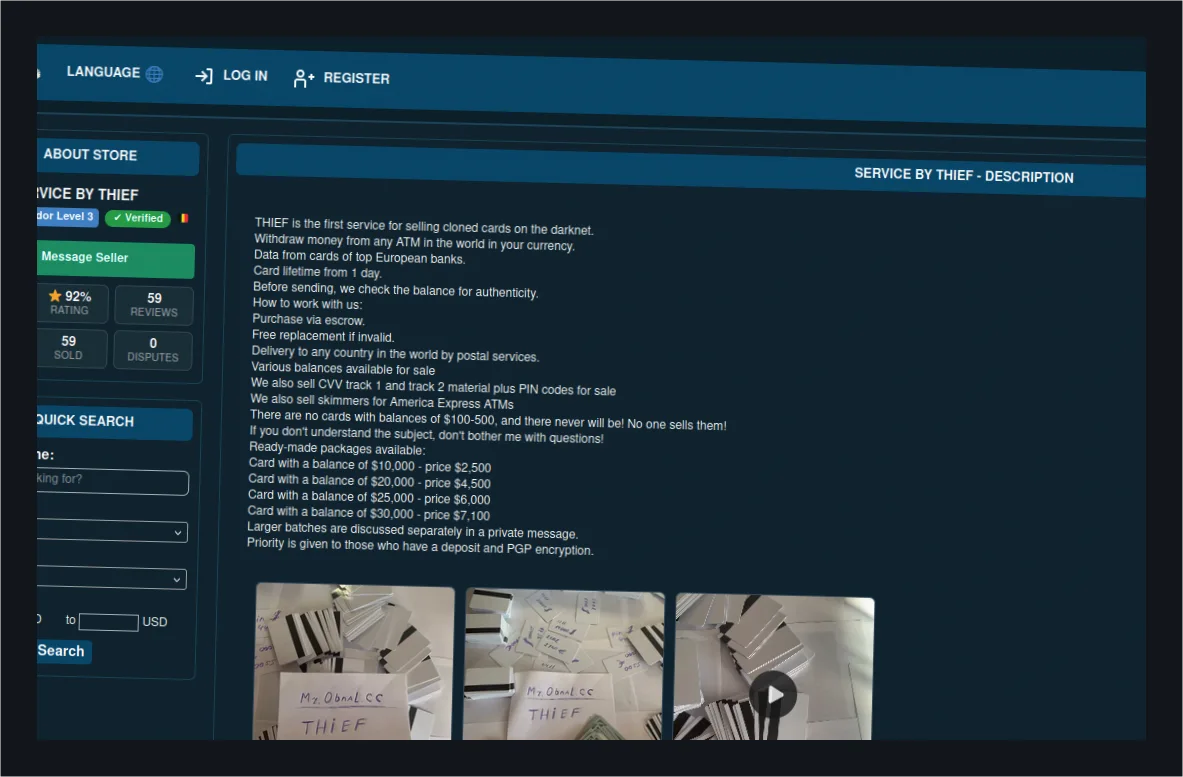
The website where the purchase was made offered perceived anonymity that dissolved under investigation.
 Vendor Reviews on the DarknetLearn about vendor reviews on the darknet to make informed purchasing decisions and enhance your safety while shopping.
 How to Access Darknet MarketsLearn how to access darknet markets safely and anonymously with step-by-step instructions for beginners.
 Vendor rating darknetExplore vendor ratings in the darknet to make informed purchasing decisions and enhance your safety while shopping.